
Hydroponic Tools & Calculators for Home Growers
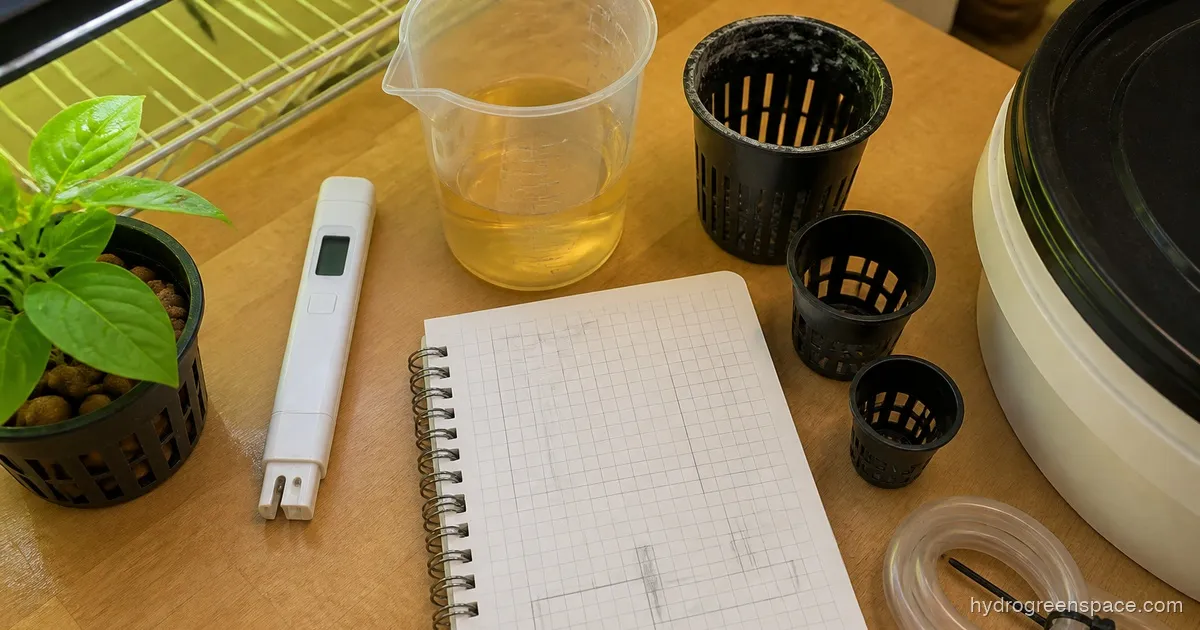
Every grower I know started out with the same problem: too many variables, not enough clarity. You’re trying to dial in your nutrient solution, figure out whether your grow light is actually delivering enough light, and wonder if your reservoir is even the right size for what you’re trying to grow.
This page is a directory of free digital tools and calculators built specifically for home growers. No gear lists, no shopping guides. These tools take your numbers and give you answers. Plug in your setup, get a result you can act on.
If you’re just starting out, the planning calculators will save you from building a system that costs more than it grows. If you’re already running a system, the chemistry tools help you stop guessing at nutrient ratios and pH adjustments. Bookmark this page and come back whenever you’re setting up something new or troubleshooting a problem.
Planning Your Setup
Hydroponic Reservoir Size Calculator: Plan Your Setup
One of the most common first-build mistakes is undersizing the reservoir. Too small, and your water parameters swing wildly between top-offs. Too large, and your nutrient solution sits unused long enough to degrade. The right volume depends on your system type, plant count, and how big those plants will get at peak growth. A general rule: leafy greens need about 0.5 gallons per plant minimum, while fruiting plants like tomatoes or peppers need 2 to 3 gallons each just to stay stable. The reservoir size calculator takes all of that into account and gives you a minimum and target volume you can shop to.
What size reservoir do I need for hydroponics? There’s no single answer, but the calculator handles the math once you input your system type, plant count, and plant size category.
For the full guide, see Hydroponic Reservoir Size Calculator: Plan Your Setup
Hydroponic Plant Spacing Calculator: Plan Your Grow
Packing plants too close is one of those mistakes that doesn’t show up until week 4 or 5, when suddenly nothing is getting airflow and your canopy is a humidity trap. Spacing requirements vary dramatically by crop type and system. Lettuce in a NFT channel needs about 6 to 8 inches between plants. Basil can handle less. Tomatoes in a Dutch bucket system need 12 to 18 inches of clearance minimum. The plant spacing calculator takes your grow area dimensions and crop type and tells you how many plants you can run per cycle with the recommended row layout.
For the full guide, see Hydroponic Plant Spacing Calculator: Plan Your Grow
Hydroponic Startup Cost Calculator: Real Numbers
Starting a hydroponic system without a clear budget is how growers end up mid-build with a half-finished setup and no money left for the parts that actually matter. The startup cost picture depends on which system you choose, how big your grow space is, what lighting type you go with, and how many plants you want to run. These variables interact in ways that aren’t obvious until you price it out. The hydroponic startup cost calculator breaks down one-time equipment costs and estimated monthly operating expenses so you can see the real number before you buy anything.
What equipment do beginners need for hydroponics? At minimum: a reservoir, a pump, a growing medium, net pots, a pH meter, a TDS or EC meter, and lights. The startup calculator helps you estimate what that actually costs for your specific setup size.
For the full guide, see Hydroponic Startup Cost Calculator: Real Numbers
Nutrients and Water Chemistry
Hydroponic Nutrient Calculator
Measuring nutrients by hand sounds simple until you’re standing over a 20-gallon reservoir with three bottles in front of you, trying to remember if the manufacturer’s dilution rate is for soft water or hard water. The math gets complicated fast when you’re adjusting for growth stage or working with a multi-part formula. The hydroponic nutrient calculator takes your reservoir size, growth stage, and nutrient brand and returns exact ml or gram amounts alongside target EC and PPM ranges. No more estimating.
How do I calculate nutrients for hydroponics? You need to know your reservoir volume, your target EC for the current growth stage, and your nutrient product’s EC contribution per ml. The calculator handles the conversion for you.
For the full guide, see Hydroponic Nutrient Calculator
Hydroponic pH Adjustment Calculator
pH is the single most misunderstood variable in hydroponics. You can have a perfect nutrient solution and still see deficiency symptoms if your pH is off, because most nutrients lock out at the wrong pH range. The sweet spot for most hydroponic crops is 5.5 to 6.5, with 5.8 to 6.2 being the narrowest target that keeps everything available. The problem is that pH Up and pH Down are strong, and the amount you need changes with reservoir volume. A few drops too many and you’ve overshot in the other direction. The pH adjustment calculator takes your current pH, target pH, and reservoir size and tells you exactly how much to add.
How do I check pH in hydroponics? A digital pH pen or meter is the right tool. Dip strips are too imprecise for regular monitoring. Calibrate your meter weekly with buffer solution, and measure pH after nutrients are fully mixed.
For the full guide, see Hydroponic pH Adjustment Calculator
EC to PPM Converter: Pick Your Scale (500/700)
If you’ve ever seen feeding charts list a target of 1400 PPM and your meter reads 980 PPM on the same solution, the problem isn’t your meter. It’s the scale. EC meters measure electrical conductivity in mS/cm. PPM meters convert that conductivity reading to parts per million using a multiplication factor, but there are three common factors in use: 500 (North American standard), 640 (Hanna instruments), and 700 (European standard). The EC to PPM converter runs the conversion in both directions and lets you pick your actual meter scale so your numbers match your feeding chart.
What is EC in hydroponics? EC stands for electrical conductivity. It measures how many dissolved salts are in your water, which gives you a reliable proxy for nutrient concentration. Higher EC means more dissolved nutrients. Most vegetative crops target 1.2 to 2.0 mS/cm. What PPM should my hydroponic water be? Translated to PPM on the 500 scale, that’s roughly 600 to 1000 PPM depending on crop and growth stage.
For the full guide, see EC to PPM Converter: Pick Your Scale (500/700)
Hydroponic Nutrient Schedule Generator
A nutrient schedule is just a repeating pattern of feed, check, and adjust, but getting the week-by-week progression right is where most growers lose the plot. Seedlings need almost nothing. Vegetative growth needs nitrogen-heavy feeding. The transition to flower or fruit requires a phosphorus shift. Managing that progression by feel leads to underfeeding early and overfeeding late. The nutrient schedule generator builds a week-by-week EC and PPM schedule tuned to your plant type, system, reservoir size, and starting week so you have a reference point for every stage.
For the full guide, see Hydroponic Nutrient Schedule Generator
Lighting
Grow Light DLI Calculator: PPFD to Daily Light Integral
PPFD gets all the attention on grow light spec sheets, but PPFD alone doesn’t tell you whether your plants are getting enough total light over the course of a day. Daily Light Integral (DLI) is what actually drives growth. DLI combines your light intensity (PPFD) with how many hours per day you run your lights. A high-PPFD light running 12 hours and a medium-PPFD light running 18 hours can deliver the same DLI. Herbs and leafy greens generally target 12 to 17 mol/m²/day. Fruiting crops want 20 to 30. The grow light DLI calculator converts your PPFD reading to DLI, and runs in reverse so you can calculate required light hours from a target DLI.
How do I calculate how much light my plants need? Measure your PPFD at canopy level with a PAR meter (or get the manufacturer’s PPFD map), then plug it into the DLI calculator along with your planned photoperiod.
For the full guide, see Grow Light DLI Calculator: PPFD to Daily Light Integral
Costs and ROI
Hydroponic Electricity Cost Calculator
Electricity is one of those costs that sneaks up on you. Lights, pumps, air stones, climate control, fans: add them up across a year of continuous operation and the number is often higher than growers expect. The electricity cost calculator takes your equipment wattages, daily run times, and local electricity rate and tells you what you’re spending per month and per year. Run it before you buy, and run it again if you’re considering a lighting upgrade.
For the full guide, see Hydroponic Electricity Cost Calculator
Hydroponic Electricity Cost Analysis
If you already have a running system and want to understand where your power budget is actually going, the electricity cost analysis tool breaks your consumption down by device category: lights, pumps, and climate control. It also shows a side-by-side comparison of HPS versus LED running costs so you can see exactly what switching buys you in annual savings.
For the full guide, see Hydroponic Electricity Cost Analysis
Hydroponic vs Soil Cost Calculator
Running the numbers on hydroponics versus soil is harder than it looks because both approaches have completely different cost structures. Soil setups have lower upfront costs but ongoing expenses for amendments, replacement media, and pest management. Hydroponic systems cost more to set up but tend to have more predictable ongoing costs. The hydroponic vs soil cost calculator runs both sides simultaneously to show setup cost, year-one total, ongoing annual cost, and the break-even point between the two approaches.
For the full guide, see Hydroponic vs Soil Cost Calculator
Hydroponic Grocery Savings Calculator
The real financial case for home growing is herbs. A $4 basil plant at the grocery store lasts maybe two weeks before it wilts. A basil plant in a hydroponic system produces continuously for months. The grocery savings calculator lets you enter your crops, weekly harvest amounts, store prices, and operating costs to calculate annual savings, monthly operating cost, net savings, and a break-even timeline. Run it before someone tells you “it’s cheaper to just buy vegetables.”
For the full guide, see Hydroponic Grocery Savings Calculator
Hydroponic ROI Calculator: Free Break-Even Tool
The grocery savings calculator shows you what individual crops return. The hydroponic ROI calculator gives you the whole-system picture: total system cost versus total operating cost versus total grocery savings over a 3-year window. It returns a break-even period and annual ROI percentage so you can make an honest comparison before you invest in a bigger system.
For the full guide, see Hydroponic ROI Calculator: Free Break-Even Tool
Tracking and Scheduling
Hydroponic Yield Estimator
Knowing what to expect from a harvest before you plant is one of the most underrated parts of planning a grow. Yield estimates give you a target to calibrate against, and a way to spot when something is underperforming before the end of the cycle. The hydroponic yield estimator takes your system type, grow space, and crop choice and returns a realistic per-cycle and annual output estimate based on typical production rates for that combination. It won’t account for every variable, but it gives you a useful baseline.
For the full guide, see Hydroponic Yield Estimator
Germination Rate Calculator for Hydroponic Seeds
Most growers don’t track germination rate until they’ve lost a tray. If you’re planting 50 seeds and only 30 sprout, knowing your germination rate (60% in that case) lets you backward-calculate how many seeds to plant to hit your target seedling count. The germination rate calculator handles both directions: enter seeds planted and seeds sprouted to get your percentage, or enter your target seedling count to find how many seeds to plant.
For the full guide, see Germination Rate Calculator for Hydroponic Seeds
Pick one tool that matches your biggest current uncertainty, whether that’s reservoir sizing, nutrient mixing, or light intensity, and use it before your next adjustment. A single calibrated decision tends to resolve three or four problems at once. Start there.