
Nutrient Deficiency Chart for Hydroponics: Fix It Fast
Yellowing leaves are the most common panic moment in hydroponics, and they almost always lead growers to the same conclusion: “I must be missing a nutrient.” Sometimes that’s right. Often it isn’t. Before you dump your reservoir and start over, you need a fast way to diagnose what’s actually happening, because the fix for a nitrogen deficiency is completely different from the fix for a pH lockout, even when the symptoms look nearly identical.
This guide gives you a practical nutrient deficiency chart for hydroponics, explains the difference between true deficiencies and imitation ones, and walks you through the exact steps to fix each problem.
Quick-Reference Diagnostic Table
Start here. Find your symptom, match it to the most likely nutrient, and note whether it’s showing on old leaves (lower canopy) or new growth (top of the plant). That old-vs-new distinction is everything.
| Symptom | Likely Nutrient | Affected Growth | First Step |
|---|---|---|---|
| Overall yellowing, starting at bottom | Nitrogen (N) | Old leaves first | Raise EC/PPM, check pH |
| Purple stems and undersides, dark green leaves | Phosphorus (P) | Old leaves | Lower pH to 5.8–6.2 |
| Brown leaf edges, scorched tips | Potassium (K) | Old leaves | Check EC, adjust nutrient formula |
| Yellowing between green veins (interveinal chlorosis) | Magnesium (Mg) | Old leaves | Add Calmag, check pH |
| Tip burn, brown leaf margins, distorted new growth | Calcium (Ca) | New growth | Add Calmag, increase circulation |
| Yellow new leaves, green veins visible | Iron (Fe) | New growth | Drop pH to 5.5–6.0 |
| Mottled yellow patches between veins | Manganese (Mn) | New growth | Adjust pH to 5.8–6.2 |
| Abnormally small leaves, distorted growing tips | Zinc (Zn) | New growth | Flush, re-mix at correct pH |
| Hollow stems, brittle growing tips | Boron (B) | New growth | Check pH, add trace element formula |
One caveat: this table assumes your pH is dialed in and your EC is in range. If those two things are off, this chart will lead you in circles.
Mobile vs Immobile Nutrients: the Pattern That Tells You Everything
Nutrients split into two categories based on how the plant moves them around:
Mobile nutrients (nitrogen, phosphorus, potassium, magnesium) can be relocated by the plant. When supply runs low, the plant pulls these nutrients from older leaves and ships them to new growth. So deficiency symptoms show up first on the bottom of the plant, in the oldest tissue.
Immobile nutrients (calcium, iron, manganese, zinc, boron) cannot be moved once they’re locked into plant tissue. When supply runs short, the newest growth suffers first, because there’s nowhere to pull reserves from.
So the diagnostic rule is simple: deficiency on old leaves = mobile nutrient. Deficiency on new leaves = immobile nutrient. A single glance at where the problem is appearing cuts your suspect list in half.
Macronutrient Deficiencies (N, P, K)
Nitrogen Deficiency
Nitrogen deficiency is the one you’ll see most. It starts as a pale yellow on the lowest, oldest leaves and works its way upward. Plants look washed out, growth slows noticeably, and if left too long the lower leaves drop entirely. If you’re growing leafy greens, nitrogen is especially critical in the vegetative phase.
The fix is straightforward: check your EC first. A solution that’s too dilute is the leading cause of nitrogen deficiency in hydro, especially in deep water culture systems where you’re topping off with plain water. If EC is low, mix a fresh solution at the correct PPM for your growth stage.
Phosphorus Deficiency
Phosphorus deficiency shows up as purple or reddish coloring on the undersides of older leaves, sometimes with dark green tops. It’s most common in cooler water (below 65°F) because phosphorus uptake slows dramatically when root-zone temperatures drop.
A lot of growers chase this with extra nutrients when the real fix is warming the water. pH also plays a big role, as phosphorus is best available in the 5.8–6.2 range.
Potassium Deficiency
Potassium deficiency looks like leaf scorch: brown, crispy edges on older leaves, sometimes with yellow halos. It can get confused with nutrient burn, but burn typically starts at the very tips and is more uniform across the plant. Understanding NPK ratios for hydroponic plants helps you balance potassium against nitrogen and avoid these mix-up scenarios.
Secondary and Micronutrient Deficiencies
Calcium Deficiency
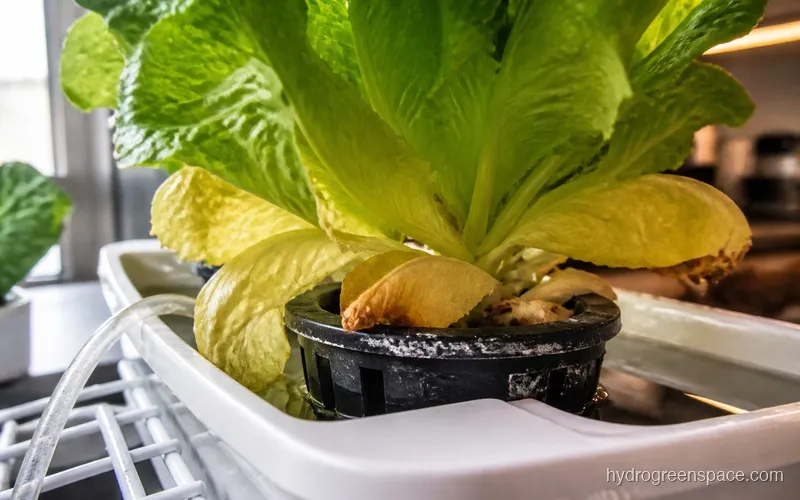
Calcium problems in hydroponics are sneaky because calcium is immobile, meaning new growth gets hit first. Tip burn on young leaves, distorted growing tips, and leaves that curl or look deformed are the common signs. It’s especially prevalent in fast-growing crops like lettuce and basil under strong lights.
Calcium is also sensitive to delivery. Even if your solution has adequate calcium, low transpiration (poor airflow, high humidity) reduces uptake dramatically. Before adding more Calmag, make sure your circulation and airflow are solid. For more detail on what each micronutrient does in your system, the connection between calcium and cell wall formation explains why new tissue gets the worst of it.
Magnesium Deficiency
Interveinal chlorosis on older leaves is the textbook magnesium deficiency look. The veins stay green while the tissue between them turns yellow, giving leaves a striped or mottled appearance. It’s one of the most visually distinctive deficiencies to identify.
Magnesium is mobile, so it shows on lower leaves first. Calmag covers this well, but check your pH is in range before adding more product. A lockout at pH 7.0+ will prevent uptake no matter how much magnesium is in your reservoir.
Iron Deficiency
Iron deficiency shows as bright yellow new growth with visible green veins (interveinal chlorosis on new leaves specifically). It looks dramatic. It’s also frequently caused by pH being too high rather than iron actually being absent from your solution.
Iron is least available above pH 6.5 in hydroponic systems. If your iron levels look fine but new growth is pale yellow, pH lockout is almost certainly the cause. Check your EC levels against this chart and verify your pH is in the 5.5–6.0 sweet spot for iron availability.
Is It Really a Deficiency?
Three things consistently mimic nutrient deficiencies in hydroponic systems, and adding more nutrients won’t fix any of them.
pH Lockout
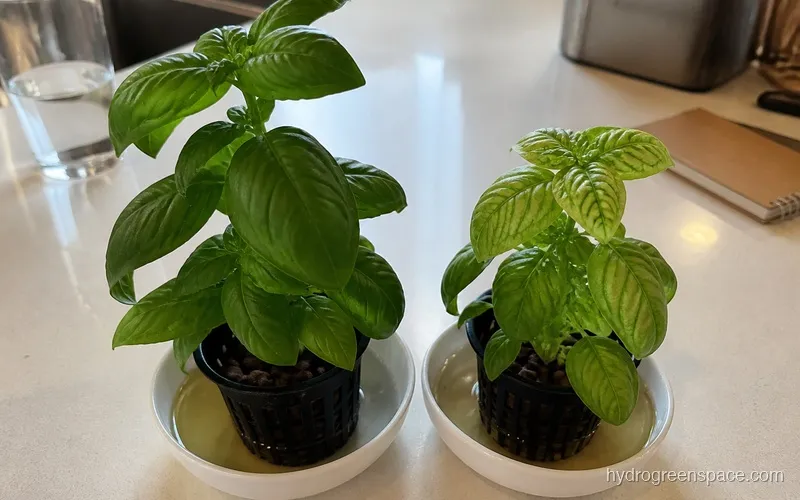
pH lockout is the most common false deficiency in hydroponics. Each nutrient has a specific pH range where it’s soluble and available to roots. Step outside that window and the nutrient can be physically present in your reservoir but completely inaccessible to the plant.
The classic scenario: you see yellowing, check your nutrient levels, they look fine, so you add more. Nothing improves. That’s pH lockout. Check your pH first, every time. If it’s outside 5.5–6.5, fix that before touching your nutrient formula. For a deeper breakdown of what happens when pH swings, see pH swings that cause deficiency-like symptoms.
EC Too Low (Weak Solution)
If your EC is below the target for your growth stage, your plants are simply hungry, not deficient in a specific nutrient. The symptoms look similar to nitrogen deficiency but across the whole plant. Comparing your PPM readings by growth stage gives you an easy reference to check where you should be. Seedlings typically run 500–700 PPM; late veg and fruiting plants can push 1,200–1,800 PPM depending on species.
Root Problems
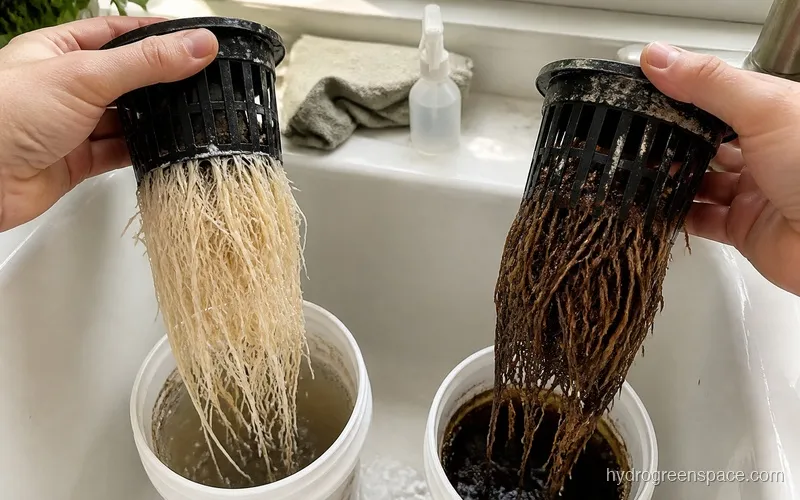
Damaged roots can’t absorb anything effectively, so a plant with root rot will show what looks like a cascade of deficiencies across multiple nutrients all at once. If you’re seeing a broad, nonspecific decline (yellowing, wilting, slow growth across the board) and your pH and EC are both fine, pull a plant and look at the roots. Healthy roots are white and slightly fuzzy. Brown, slimy, or smelly roots mean root rot can mimic deficiency symptoms and no amount of nutrient adjustment will fix it.
How to Fix a Nutrient Deficiency: Step-by-Step
When you’ve identified the deficiency (or the mimic), here’s the sequence to work through:
- Check pH first. Get it into 5.5–6.5 range. If it was off, wait 24–48 hours before doing anything else.
- Check EC/PPM. Compare to the target for your current growth stage. If it’s low, mix a fresh solution.
- If pH and EC are fine, you have a true deficiency. Add the relevant supplement (Calmag for calcium/magnesium, a trace element mix for iron/manganese/zinc, or a higher-nitrogen formula for nitrogen deficiency).
- Flush and refill if you suspect nutrient imbalance or salt buildup. Drain the reservoir completely, rinse the system with plain pH’d water, then mix a fresh solution from scratch.
- Give it 3–5 days before judging the result. Damaged leaves won’t recover, but you should see new growth coming in healthy if the fix worked.
One thing to remember: the line between deficiency and nutrient burn is narrow. If your EC was already at or above the high end of the target range and you see symptoms, adding more nutrients will make things worse, not better. Flush first, then re-evaluate.
What I’d do: When I can’t immediately identify a deficiency, I always flush and start fresh with a clean reservoir at the correct EC before adding any targeted supplements. It fixes 80% of cases and prevents the “layered supplement” problem where you’ve added so many extras that your solution is out of balance.
Once you’ve confirmed a true deficiency and corrected it, the next step is making sure your baseline nutrient formula is properly balanced so the problem doesn’t recur. Use the hydroponic nutrient calculator to dial in your exact mix and verify nothing is out of ratio before your next reservoir change. The hydroponic nutrients guide covers how to choose a complete nutrient line and set up a reservoir schedule that prevents deficiencies from recurring in the first place.