Increasing Yields in Hydroponics: 8 Proven Levers
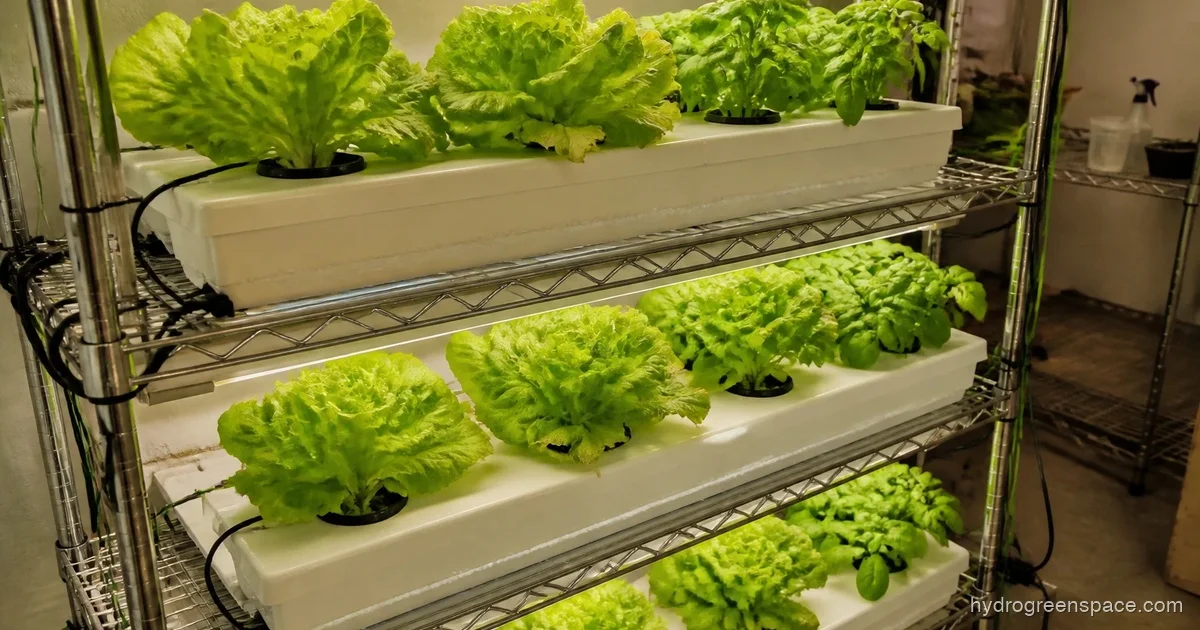
Most hydroponic growers plateau after their first few successful harvests. The plants are alive, they’re growing, things look fine, but yields aren’t climbing. The problem usually isn’t the system or the strain. It’s that the levers that actually move the needle aren’t obvious, and they interact in ways that matter.
This guide is structured around the eight factors that have the biggest impact on hydroponic yields. I’ll tell you which ones to tackle first (they cost almost nothing), which require more setup, and how they interact so you’re not optimizing one thing while accidentally sabotaging another.
Does Hydroponics Actually Yield More Than Soil?
The short answer: yes, significantly. Studies consistently show hydroponic crops producing 20–50% more yield than soil-grown equivalents in the same space, and the fastest-growing crops like lettuce can yield 3–4x more when you account for grow cycles per year. The reasons are straightforward: plants don’t burn energy searching for water and nutrients, roots stay in their ideal environment, and you control every variable.
But “hydroponics yields more” is only true when those variables are dialed in. A stressed hydroponic plant in a neglected system will underperform a healthy soil plant every time. That’s what the rest of this article is about.
The Eight Levers: Quick Wins vs. Advanced Moves
Before diving in, here’s the honest breakdown. These levers are not equal. Some cost you nothing and take an afternoon. Others require equipment and a learning curve. Here’s how I’d prioritize them if you’re starting from where most home growers are:
Quick wins (tackle these first):
- Light intensity and duration (free if you already have a good fixture)
- Root zone oxygen (usually free or cheap)
- Nutrient EC/PPM calibration (just costs you a decent meter)
- Training and plant density adjustments
Advanced moves (worth it, but not your first step):
- CO2 supplementation
- Beneficial microbes and root inoculants
- Succession planting for continuous harvest
- System optimization and upgrades
Lever 1: Light Is Everything (Daily Light Integral First)
If you optimize nothing else, optimize light. It’s the single biggest driver of photosynthesis, and photosynthesis is the engine behind every gram of yield you harvest.
The metric that matters most is Daily Light Integral (DLI), which measures the total amount of light energy your plants receive over a full day. It’s expressed in mol/m²/day. Most vegetables need somewhere between 20–40 DLI for peak production, with fruiting crops like tomatoes and peppers pushing toward the high end.
The practical implication: more light, more yield. But there’s a ceiling. Push DLI too high without matching it with CO2 and water, and you’ll actually suppress growth. For most home growers, the ceiling before you need supplemental CO2 is around 35–40 DLI.
What I’d do: Before buying a new light, measure your current PPFD with an app like Photone (it’s not lab-accurate but it’s directional). Most home growers running older blurple LEDs are operating at 50–100 PPFD when their plants want 400–600 PPFD for vegetative growth and 600–900 for flowering.
If light is the engine, photoperiod is the fuel schedule. Getting your light cycle right for each crop stage can add yield without changing a single piece of hardware. For a deeper breakdown of DLI targets by crop, the DLI guide for hydroponic plants covers the numbers in detail.
Lever 2: Root Zone Oxygen (The Underrated Yield Driver)
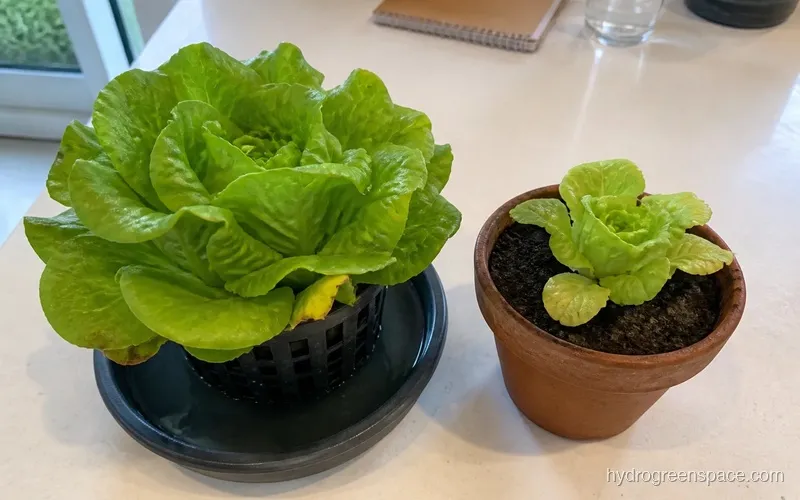
Roots need oxygen just as much as leaves do. In soil, air pockets provide it naturally. In a hydroponic system, oxygen in your reservoir is the difference between roots that thrive and roots that suffocate.
Dissolved oxygen (DO) levels should sit between 7–10 mg/L for optimal uptake. Below 6 mg/L and you’ll see slowed growth; below 4 mg/L and you’re on your way to root rot.
The factors that kill dissolved oxygen levels:
- Warm reservoir temperatures (anything above 72°F drops DO fast)
- Insufficient aeration
- Stagnant water zones in the system
For DWC and similar systems, an air pump sized properly for your reservoir volume is non-negotiable. Aim for at least 1 watt of air pump per gallon. Keep reservoir temps between 65–70°F. This is one of the cheapest interventions with the highest yield impact, and most growers who plateau have a reservoir that’s too warm and under-aerated.
Lever 3: Nutrient EC/PPM: Don’t Guess, Measure
Plants can’t absorb nutrients they can’t access, and they can’t absorb nutrients at all if the concentration is wrong in either direction. EC (electrical conductivity) is how we measure nutrient concentration in solution, and PPM (parts per million) is the same measurement on a different scale.
The broad guidelines:
| Growth Stage | EC Range | PPM (500 scale) |
|---|---|---|
| Seedling / Clone | 0.8 – 1.2 | 400 – 600 |
| Vegetative | 1.2 – 2.0 | 600 – 1,000 |
| Flowering / Fruiting | 1.8 – 2.5 | 900 – 1,250 |
| Late Flush | 0.5 – 0.8 | 250 – 400 |
Going higher than these ranges doesn’t increase yield; it causes nutrient lockout and toxicity. Going lower starves the plant. For a detailed breakdown by crop and system type, our hydroponic EC chart is the reference I use every grow.
EC needs go up as plants approach peak flowering, and they come back down for the final flush. Running the same EC from seedling to harvest leaves yield on the table at every stage.
Lever 4: Plant Density (More Plants Isn’t Always More Yield)
You can pack more plants into a space (increasing plants-per-square-foot), or you can give each plant more space and maximize per-plant yield. Which is right depends on what you’re growing and your system.
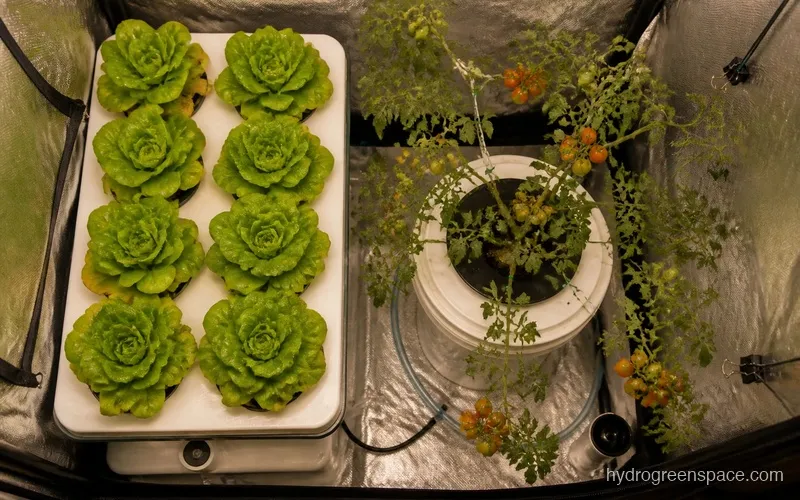
For leafy greens like lettuce and spinach, high density wins. Lettuce at 8–12 plants per square foot in an NFT channel consistently outproduces 4 plants per square foot in terms of total grams harvested. These plants don’t compete meaningfully at close spacing and mature fast enough that the individual plant size doesn’t matter.
For fruiting crops (tomatoes, peppers, cucumbers) the math flips. A tomato plant given 3–4 square feet will outproduce three tomatoes crammed into the same space. They need light penetration, airflow, and root zone space to set and develop fruit.
The Sea of Green method is built around high-density short-cycle production. SCROG (Screen of Green) is the opposite approach, training one or a few plants to fill a canopy efficiently. Both maximize yield per square foot, just through different approaches.
Lever 5: Training Techniques for More Canopy, More Yield
Even in a well-lit space, lower branches get shaded. Light that hits a leaf produces sugar; light that hits the floor produces nothing. Training techniques redirect plant energy to the parts of the plant that will actually bear fruit or fill out a harvestable canopy.
The fundamentals:
- Low Stress Training (LST): Bending and tying stems to create a flat canopy. No cuts, minimal recovery time, accessible to beginners.
- Topping: Cutting the main stem to produce two main colas instead of one dominant apical tip. More sites, more yield, but it requires a recovery period.
- Defoliation: Removing leaves that block light from the lower canopy. Has to be done carefully, because removing too much reduces photosynthesis.
For a complete how-to on each approach, pruning and training techniques for hydroponics covers all three with timing recommendations by stage.
Lever 6: CO2 Supplementation: Real Gains, Real Caveats
Plants use CO2 to build sugars via photosynthesis. Ambient CO2 is around 400 ppm. Elevating it to 1,000–1,500 ppm can increase yields by 20–40%, but only if light intensity is already maximized. CO2 without adequate light does essentially nothing.
This is an advanced move with a real cost (CO2 tanks or a generator, a controller, proper sealing of your grow space). If you’re still running underpowered lights or haven’t addressed root zone oxygen, CO2 is not your next step.
For home growers with sealed tents running high-output LED fixtures and already hitting 35+ DLI, CO2 supplementation is worth exploring. The yield gains are real when everything else is in place.
Lever 7: Beneficial Microbes (The Long Game)
This one gets skipped in most content because the results aren’t immediate and the mechanism isn’t obvious. But the evidence is solid: mycorrhizal fungi and beneficial bacteria improve nutrient uptake efficiency, increase root mass, and suppress pathogen pressure.
In a hydroponic system, you’re working against yourself if you use sterile reservoirs and harsh additives that kill biology. Building a living root zone, even in a water-based system, pays dividends over a full grow cycle.
Mycorrhizae in hydroponics covers how to apply these inoculants without disrupting your nutrient solution. If you want to go deeper on the bacterial side, beneficial bacteria for hydroponics is the companion piece.
Lever 8: Dialing In Your System and Choosing the Right One for Your Goals
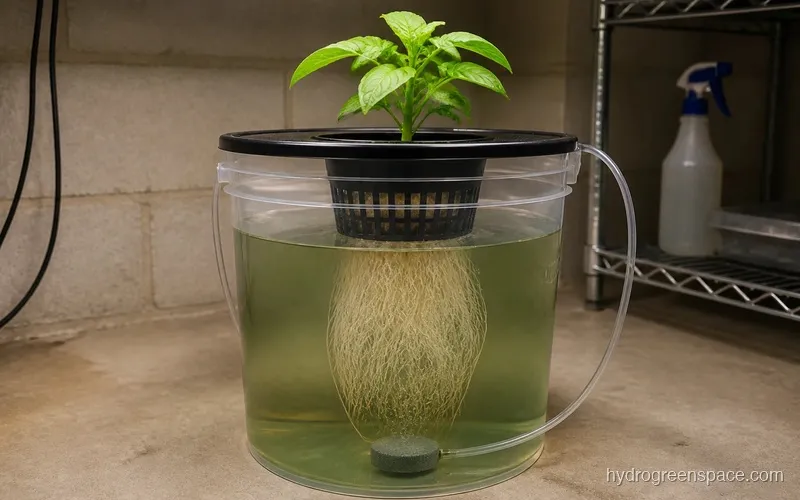
The type of hydroponic system you run has a ceiling on what’s achievable. DWC and RDWC (recirculating DWC) are consistently the highest-yielding systems for home growers because roots have constant access to oxygen-rich, nutrient-dense water. NFT is excellent for leafy greens. Drip systems scale well for fruiting crops.
The highest-yielding systems commercially are aeroponic (roots misted with nutrient solution rather than submerged), but they’re technically demanding, prone to pump failures, and overkill for most home operations. DWC done well beats aeroponics done poorly.
The bigger point: if you’re running a passive system like Kratky for anything beyond herbs and small greens, you’ve hit the ceiling of what that system can do. Switching to active recirculation is a genuine yield upgrade.
What Grows Fastest With the Highest Yield?
If you just want numbers: lettuce, kale, and spinach are the fastest with the highest yield-to-space ratio. A well-run DWC lettuce setup can produce a harvest in 30–35 days. Basil and herbs are close behind.
For fruiting crops, tomatoes win on total weight per plant. A single hydroponic tomato plant grown in an active system with proper support and training can yield 10–20 lbs over a season. Peppers and cucumbers are competitive.
For actual yield projections based on your system size and crop, the hydroponic yield estimator lets you run the numbers before you commit to a grow plan.
Putting It Together
The growers who see the biggest yield gains don’t chase one optimization at a time. They fix the fundamentals first (light, oxygen, and nutrition) and then layer in training, density adjustments, and eventually biological inputs. The framework holds across systems, crops, and experience levels.
If you’re working on building this foundation and want a structured path forward, the advanced hydroponic techniques hub covers where all of these levers fit in your overall grow strategy. Start with light and oxygen, measure everything, and let the plants tell you when the baseline is solid enough to go deeper.